Blog · 29 October 2026 · 5 min read
The Hidden Carbon Cost of Festival Connectivity
An article discussing why event organisers are now expected to report on carbon, land impact and waste, and that connectivity is quietly moving from an afterthought to a line item in the sustainability audit.

Ombiy Events
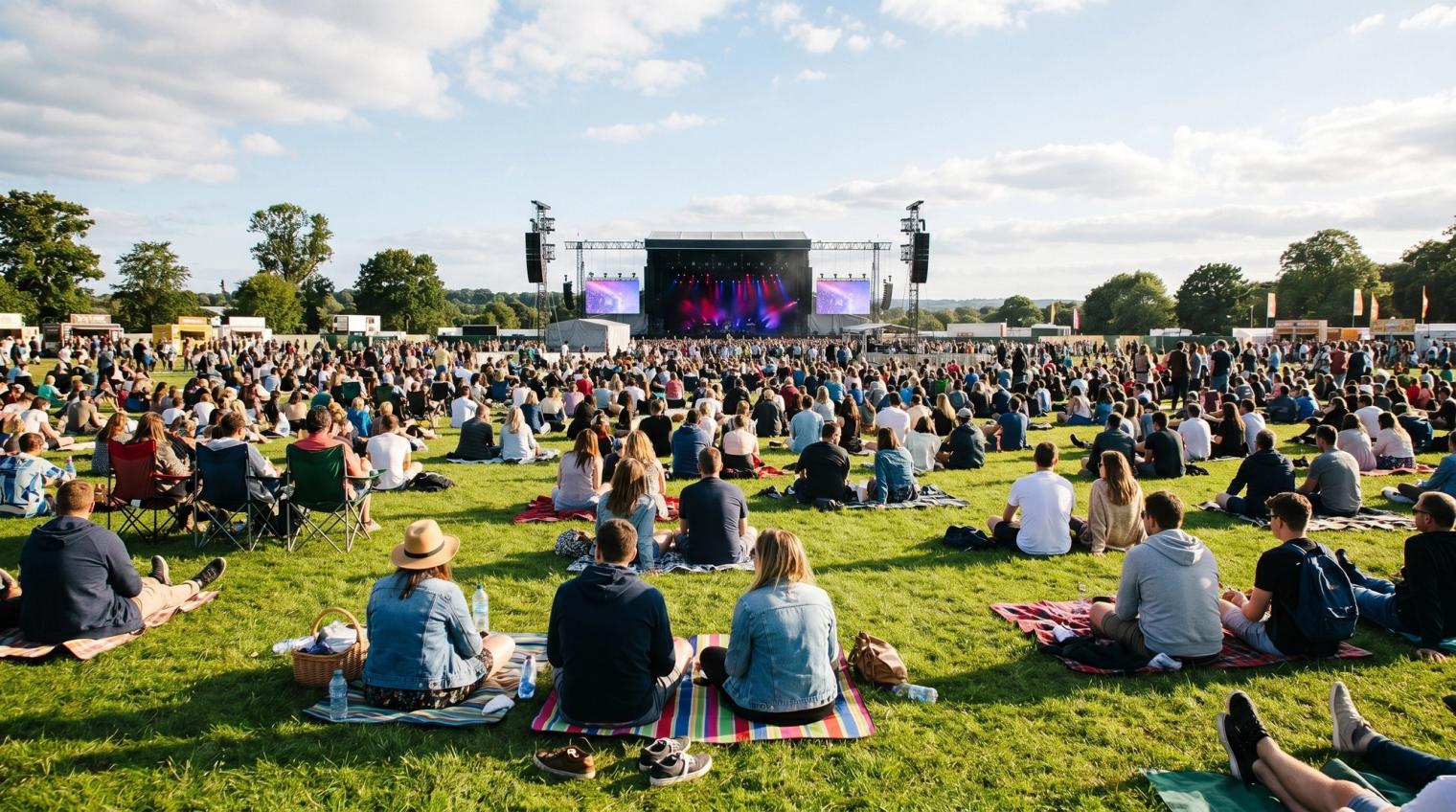
Six Kilometres of Cable, or None at All? The Hidden Carbon Cost of Festival Connectivity
6-minute read
We've just returned from the Showman's Show at Newbury Showground, and as ever, the most useful part was the conversations. When the topic turned to event connectivity, poor signal was almost always first on the list, and everyone in the room knew what that means: traders losing sales, queues at the bars, and a crowd that remembers the buffering more than the band.
What surprised us was how often a second subject came up alongside it: the green one.
Organisers are now expected to report on carbon, land impact and waste, and it was clear at Newbury that connectivity is quietly moving from an afterthought to a line item in the sustainability audit. Rightly so. Walk across a festival site a month before gates open and, if the organiser has gone the traditional route, you'll find a mini excavator slowly carving a trench from the car park to the campsite. On a typical layout, that run adds up to around six kilometres of buried cable.
OMBIY Events Private 5G approach replaces it with a handful of radios on temporary masts, deployed in days rather than weeks, with no trench at all. Every saving in time, materials and machinery shows up on the carbon ledger too.
Here's what the difference between six kilometres of cable and none at all means for the planet, not just the budget.
Anatomy of a Typical Festival Site
Our example site has seven zones, each with its own connectivity demands:
- Main Stage. Production, broadcast, lighting and sound networks
- Fair. Card payments, ride control, queue management
- Big Top. Secondary stage, streaming, crew comms
- Food Village. Dozens of traders taking contactless payments at once
- Glamping. Guest Wi-Fi, check-in, security
- Car Park. Ticket scanning, ANPR, traffic management
- Campsite. Welfare, lost property, wristband top-ups
Connecting them all by cable means a ring-and-spur layout from a central comms compound. Once you've routed around stages, tracks and fire lanes, that comes to roughly 6 km of trenching.
The Traditional Route: What 6 km of Cable Really Costs
The cable itself is only the visible part. The real cost is everything it takes to get it into the ground, and out again.
Weeks of work before a single ticket is scanned
A cable build typically needs a crew on site two to three weeks before the event: surveying, trenching, laying duct, pulling cable, terminating, testing, then reinstating the ground. That's diesel plant running all day, vans commuting to a greenfield site, and welfare units, powered by generators.
Material that mostly goes to waste
Temporary installs are rarely recovered intact. Armoured cable gets cut at every junction, duct is damaged on extraction, and much of it is scrapped. A large share of what goes into the ground never gets used again.
Ground damage and reinstatement
Trenching across pasture compacts soil, disturbs drainage and leaves scars that take seasons to recover, often requiring reseeding and additional site-restoration work that landowners notice and remember.
The illustrative carbon footprint required is 6 km of cable.
These are order-of-magnitude estimates based on typical industry emissions factors.
| Activity | Assumption | Est. CO₂e |
|---|---|---|
| Trenching & reinstatement plant | ~60 machine-hours at ~5 L diesel/hr | ~0.8 t |
| Cable & duct manufacture | ~6 km armoured cable + HDPE duct | ~8–12 t |
| Crew travel | 2 vans × 15 days × ~80 km | ~0.6 t |
| Generator for site compound | 3 weeks pre-event running | ~1.5 t |
| Waste disposal / scrappage | 30–50% of cable not reused | ~0.5 t |
| Total | ≈ 11–15 t CO₂e |
For context, that's roughly the annual emissions of two to three UK households spent before the first act has even sound-checked.
The OMBIY Events Route: Private 5G, Zero Trenches
A private 5G network for an outdoor event is a temporary deployment. It goes up with the rest of the build and comes down with it.
A few radios, whole-site coverage
Typically, just 2–5 radios can blanket an entire festival site, stadium or race circuit, covering every zone from the car park to the campsite. No ring, no spurs, no excavator.
One accountable partner, days not weeks
OMBIY Events provides dedicated Private 5G and Wi-Fi for events of any scale, acting as a single accountable partner that turns connectivity into smoother operations. Deployment is measured in days, with a small team and no heavy plant.
Familiar Wi-Fi for everyone on site
Traders, production and glamping guests connect through compact hire devices that deliver standard Wi-Fi to phones, tablets and laptops, all powered by the on-site Private 5G network. No cables to the food village, no patch panels in the big top.
Illustrative carbon footprint for an event using Ombiy Events Private 5G
| Activity | Assumption | Est. CO₂e |
|---|---|---|
| Equipment transport | 1 van, 2 trips | ~0.1 t |
| Mast & radio deployment | 2–3 days, 2 engineers | ~0.1 t |
| Power for radios | Hybrid battery/solar or mains spur | ~0.2 t |
| Equipment manufacture (amortised) | Reused across dozens of events | ~0.3 t |
| Total | ≈ 0.7 t CO₂e |
Side by Side
Put the two approaches next to each other, and the gap is hard to ignore.
| Factor | Traditional Cable | Ombiy Events Private 5G |
|---|---|---|
| Cable in the ground | ~6 km | 0 m |
| Pre-event setup | 2–3 weeks, crew of 6+ | 2–3 days, crew of 2–3 |
| Heavy plant on site | Excavator, trencher, cable drums | None |
| Material wastage | 30–50% scrapped | Radios reused event after event |
| Ground disturbance | Trenching across every zone | Temporary mast footings only |
| Est. CO₂e | 11–15 t | ~0.7 t |
| Saving | ~90–95% |
The headline: a Private 5G deployment can cut connectivity-related emissions by more than 90%, while removing weeks from your build schedule and leaving the field exactly as you found it.
Why This Matters for Your Sustainability Report
Connectivity rarely features in festival carbon audits, which tend to focus on audience travel, power and waste. Yet the pre-event build is one of the few areas organisers fully control, and it's where the fast wins live.
Swapping trenched cable for Private 5G gives you:
- A measurable Scope 3 reduction. You can put it straight into your sustainability report.
- Less land disturbance. A tangible benefit for landowners and local councils, and a stronger hand when negotiating next year's site.
- Fewer plant and generator hours. Cutting noise and diesel on site during the build.
- Circular equipment. Equipment that works dozens of events a year instead of being scrapped after one.
And the operational benefit that started the conversation at Newbury doesn't go away: the traders get a signal that works at peak, the production team gets a network built for them, and the crowd gets an experience that doesn't buffer.
Six kilometres of cable, or none at all. For the ground, the schedule and the carbon ledger, the answer is getting easier every season.